
Former Soviet Republic is deeply divided between EU and Russian supporters
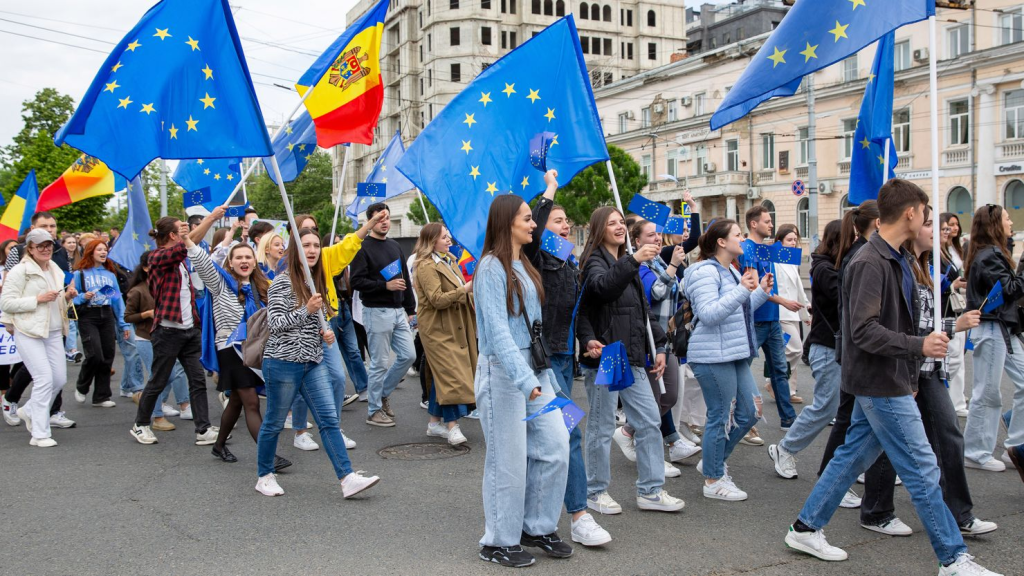
Young people wave EU and Moldovan flags in Chisinau, Moldova, to celebrate Europe Day. AFP/Getty Images
Moldova elections have sparked a geopolitical battle between the European Union (EU) and Russia.
The former Soviet Republic is deeply divided between supporters of EU integration and those advocating closer ties with Moscow. The country’s presidential election on October 20 pitted the EU-backed incumbent president Maia Sandu against pro-Russian candidates Alexandr Stoianoglo and Renato Usatii.
Sandu failed to secure a simple majority with 42.5% of the vote in Moldova’s elections, prompting a second round on November 3 and a possible weakening of EU influence. Stoianoglo, backed by the pro-Russian Party of Socialists, and Usatii, a pro-Russian member populist, came behind Sandu in second and third place, respectively.
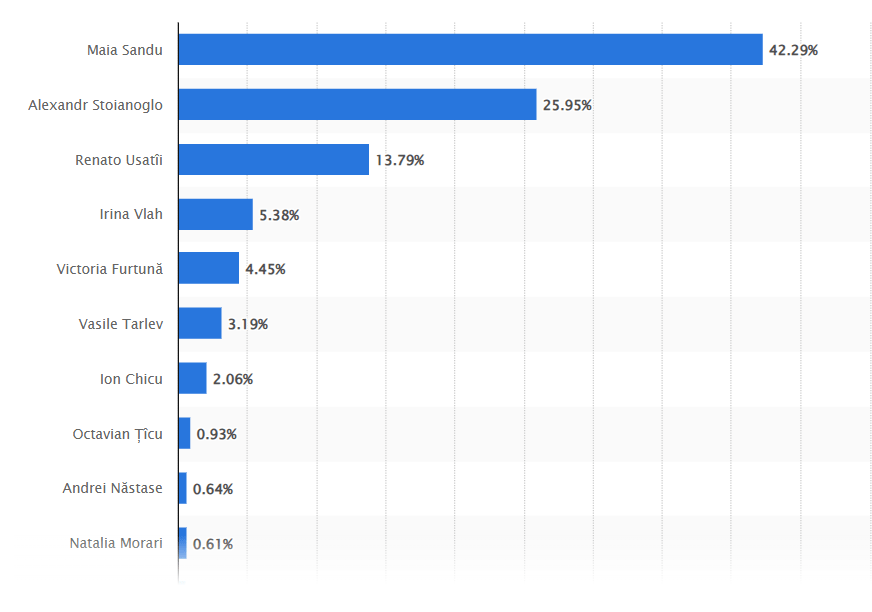
Results of the presidential election in the first round in Moldova on October 20: Statista
Moscow is trying to “regain momentum in its efforts to reconsolidate control over the post-Soviet space through the ongoing elections in Moldova,” the Institute for the Study of War wrote on October 27.
“The Kremlin continues to pursue its longstanding hybrid warfare efforts to regain effective control of the territories of the former Soviet Union even as it seeks to gain control of Ukraine through military force.”
EU Makes Gains with Moldovan Referendum
Sandu, who assumed office in December 2020, has increased Moldova’s engagement with the EU, the country’s biggest trading partner at 54% of total trade. However, the second round of elections will likely determine whether the nation aligns more closely with the West or drifts back into Moscow’s orbit.
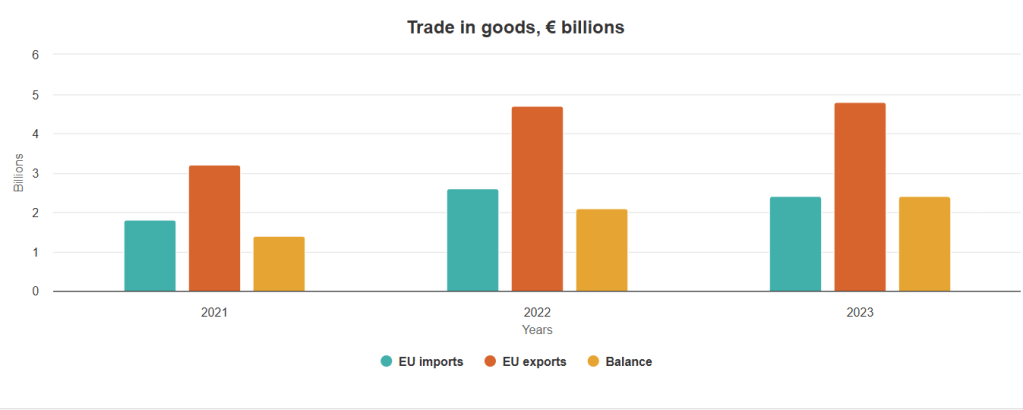
EU-Moldovan Trade, Source: EU
Sandu also won a referendum running in parallel on whether joining the EU should be enshrined in the Constitution. But she did by a slim margin of 50.5% in favor of 49.5%. Her victory relied on the support of Moldovans living in the EU.
Without it, Sandu’s push for future European integration would probably have stalled.
Pro-European supporters had to engage in a “difficult fight” as Moldova elections were subjected to an “unprecedented assault on freedom and democracy,” Sandu said. “Moldova’s enemies” bought votes that represented a “dangerous phenomenon for any democracy,” she said.
Moldovan Authorities have accused Russia of spending about $100 million to influence elections on various levels across the country. One alleged vote-buying scheme involved the transfer of $15 million to some 130,000 Moldovans. That’s $115 a person in a country with a GDP per capita of $614 monthly.
EU, White House Accuse Russia of Interference
The EU and the White House welcomed the results of the presidential elections and the referendum. However, both accused Russia of interfering in the country’s political process.
“In the face of Russia’s hybrid tactics, Moldova shows that it is independent,” EU Commission President Ursula von der Leyen said. “It is strong and it wants a European future.
Washington characterized the referendum as a “historic step forward in Moldova’s European integration. It warned that Russia may seek to meddle in the second round of the presidential elections.
“Moldova has a long road ahead in battling Russia’s deeply rooted disinformation network and vote-buying tactics,” Constance Victor, at the European Council on Foreign Relations, wrote on October 18.
On 9 October, European Parliament members adopted a resolution issuing a strong warning against Russian attempts to interfere in Moldova’s democratic process.
Moldova and the EU agreed in May on a security and defense partnership. This will enhance the country’s resilience, allow the EU and Moldova to jointly address shared security challenges, and explore new areas of cooperation and dialogue.
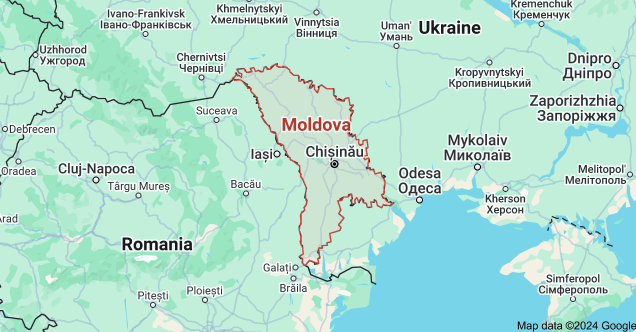
Source: Google Maps
Pro-Russian Proxies Diversify Interference Techniques
As Moldova moves closer to the EU, Russia and its pro-Russian proxies “are diversifying their interference techniques to disrupt the elections and derail the country’s EU ascension trajectory,” Victor said.
Moldovan authorities said that 300 pro-Russian Moldovans underwent protest training in a Moscow suburb, the Wall Street Journal reported. Artificial intelligence has also been deployed against Sandu. One deepfake video showed her resigning and asking voters to support a candidate widely believed to be pro-Russian in last year’s local elections.
Moldovan authorities have accused businessman Ilan Shor of working on behalf of Russia to destabilize the country’s political process. Shor has called on Moldovan authorities to “annul the referendum.”
“To derail the process, however, Moscow is not simply relying on cold, hard cash bribes,” Victor wrote. “According to local authorities in Moldova, pro-Russian proxies are – under Shor’s direction – vote-buying in their thousands.”
Russia Denies EU Accusations of Interference
Russian authorities, however, have denied any interference in the country’s political process. Kremlin spokesperson Dmitri Peskov said the government would need to provide tangible evidence to substantiate her claims that there were traces of foreign interference and election meddling.
The pro-Russian Party of Socialists, though, boycotted the referendum. Leader of the Victory Bloc Shor, who is a vocal opponent of EU integration, said that he would launch legal proceedings against the results.
The Moldovan police chief, Viorel Cernautanu, accused Shor allegedly of establishing a voter-buying scheme designed for the presidential elections. Cernautanu claimed that more than 130,000 were bribed to vote against the referendum and in favor of Russophile candidates.
The Moldovan government charged the former leader of the Shor party with fraud and money laundering in 2015 and sentenced to 7.5 years in 2017. After he appealed the verdict, Shor was eventually convicted in absentia for 15 years and now lives in Moscow.
Sandu’s Victor in Second Round Uncertain
It is unclear, though, if Sandu will win the second round of the Moldovan elections. Recent trends suggest a tight contest. Former pro-Russian governor of Gagauzia, Irina Vlah, came in fourth in the presidential elections and will likely endorse Stoianoglo.
Stoianoglo has said that he was not working on behalf of Russia. But he has also not denounced the Kremlin’s invasion of Ukraine and foreign intervention in Moldova and has called for improved relations with Moscow.
Stoianoglo has indicated, though, that he would support Moldova’s “European aspirations.”
“The Kremlin seems to have failed to adapt its election interference strategies to the new realities of Moldovan politics,” Maksim Samorukov, a fellow at the Carnegie Russia Eurasia Center, wrote in Foreign Policy on October 16.
“Even some of the pro-Russian politicians support EU membership and try to avoid being too closely associated with Moscow.”
 European Capital Insights
Leave a comment